Project Summary
This CRM platform puts AI at its core, not on the periphery. Rather than a traditional CRM with AI bolted on, Jupiter AI is deeply integrated into workflows to guide sales teams toward high-value opportunities, provide intelligent recommendations, and explain business actions transparently.
The platform manages accounts, contacts, deals, activities, and follow-ups while using AI to identify bottlenecks, prioritize opportunities, and suggest next steps. It emphasizes auditability, role-aware execution, and scalable data modeling.
Business Problem
Traditional CRMs capture data but don't guide salespeople toward success:
- • Information overload: Salespeople have hundreds of deals and contacts but no guidance on priorities
- • Missed opportunities: High-value deals fall through the cracks; low-probability deals consume time
- • Lack of insight: Why is a deal stuck? What should the next action be?
- • Attribution blind: Marketing and sales don't understand which channels drive real value
My Role
System Architect: I designed the CRM data model to support complex account hierarchies, deal tracking, multi-threaded relationships, and AI-driven scoring and recommendations.
Technical Project Manager: I led the planning and delivery of major CRM modules including account management, deal pipeline, AI recommendations, and marketing attribution.
Full-Stack Developer: I implemented core features including account and deal workflows, activity logging, AI integration points, reporting, and the user interface.
Architecture & Technical Approach
AI-First Design
Rather than adding AI as an afterthought, Jupiter AI is central to the CRM. The data model and workflows are designed around AI insights: opportunity scoring, risk assessment, recommended actions, and relationship analysis.
Account-Centric Data Model
The system is organized around accounts (companies) rather than contacts (individuals). This allows tracking multi-threaded relationships, understanding organizational structures, and managing complex B2B sales.
Jupiter AI Concept
Jupiter AI operates on a plan → confirm → execute model:
- Plan: AI analyzes the account and suggests the most valuable next action
- Confirm: The salesperson reviews and approves the recommendation
- Execute: The system guides the execution with templates, talking points, and follow-up tasks
Auditability & Transparency
Every AI recommendation is logged with reasoning. Salespeople can understand why something was suggested and can override or modify recommendations. This builds trust in AI without removing human judgment.
CRM Interface
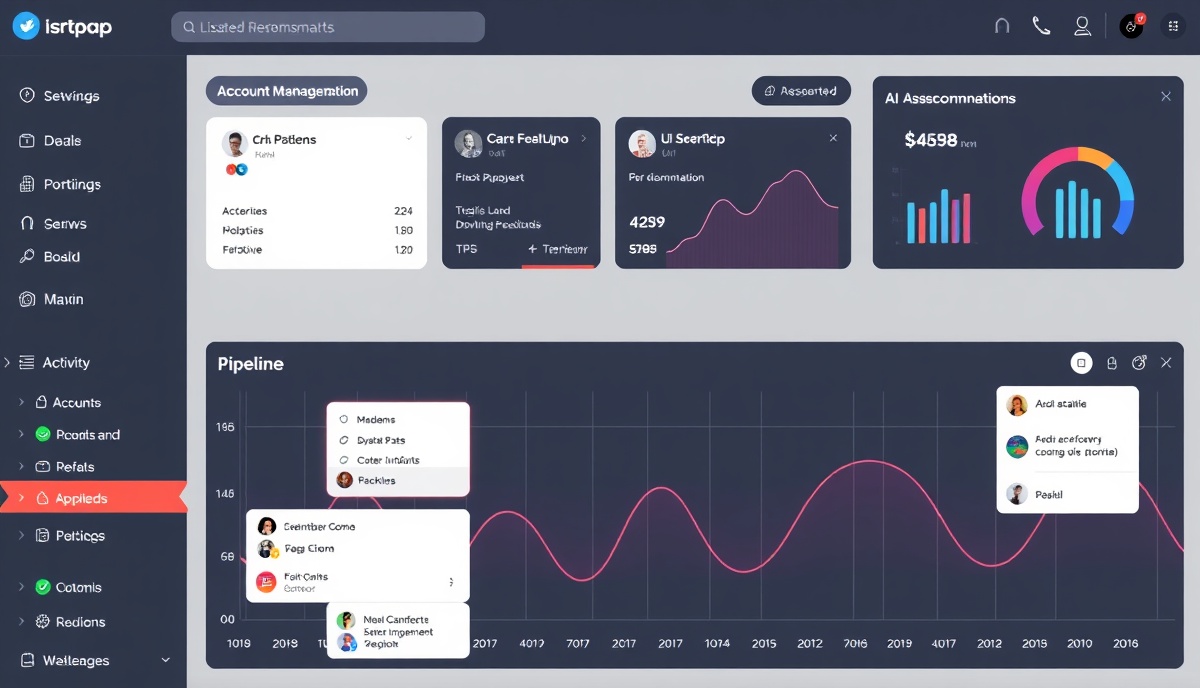
The CRM interface puts Jupiter AI at the center of the sales workflow, providing intelligence-driven recommendations, pipeline visibility, and activity tracking all in one place.
Key Features
Account Management
Account hierarchies, contact relationships, interaction history, and account health scoring
Deal Pipeline
Deals, stage management, win/loss analysis, and sales forecasting
Jupiter AI Recommendations
AI-suggested next actions with reasoning, confidence scores, and historical success rates
Activity Tracking
Calls, emails, meetings, and tasks logged automatically or manually with context
Marketing Attribution
Track which marketing channels drive qualified leads and influence deal outcomes
Reporting & Analytics
Sales metrics, pipeline health, team performance, and AI effectiveness tracking
Challenges Solved
Account-Centric Data Model
Designing a data model that handles complex account hierarchies, multi-threaded relationships, and role-based organization required careful schema design and query optimization.
AI Scoring & Recommendations
Building scoring models that are both predictive and explainable required careful feature engineering, validation, and transparency about what factors influence recommendations.
Auditability & Trust
Maintaining a complete audit trail of AI recommendations and user actions while keeping the system performant required careful logging and data structure design.
Marketing Attribution
Building accurate attribution models that connect marketing touchpoints to deals and revenue required solving the multi-touch attribution problem with sensible heuristics.
Business Value
Sales acceleration: Salespeople spend less time searching for what to do next and more time building relationships and closing deals.
Improved win rates: Jupiter AI's recommendations help salespeople prioritize high-value opportunities and apply the right strategy for each deal.
Better forecasting: Sales leaders get accurate pipeline visibility and win probability estimates powered by data and AI.
Marketing insight: Attribution models show which marketing efforts drive real revenue, enabling smarter marketing investment.
Trust in automation: Transparent, auditable AI recommendations earn sales team trust and adoption, leading to real business impact.
Interested in discussing CRM design, AI integration, or sales effectiveness?
Get in Touch